DCR vs Non-DCR Solar Modules: A Complete Guide for 2026
Learn the difference between DCR and Non-DCR solar modules, their applications, ALMM requirements, and how to choose the right solar module for your project.
Choosing the right solar module today involves much more than comparing wattage or efficiency. With India’s solar sector evolving rapidly, buyers must also consider regulatory requirements, sourcing norms, and project eligibility. One of the most common questions among project developers, EPC companies, businesses, and government agencies is whether to choose DCR solar modules or Non-DCR solar modules.
Understanding the difference is essential because selecting the wrong type of module may affect compliance with project specifications, procurement requirements, and long-term planning. This guide explains the key differences between DCR and Non-DCR solar modules, where each is used, and how to make the right choice for your project in 2026.
What Are DCR Solar Modules?

DCR stands for Domestic Content Requirement. Under specific government procurement programs, DCR solar modules are required to use solar cells and modules manufactured within India, helping strengthen domestic manufacturing and reduce dependence on imports. Official guidance is issued by the Ministry of New and Renewable Energy (MNRE) under applicable schemes and procurement rules.
The primary objective of DCR is to encourage local manufacturing, create employment opportunities, strengthen supply chains, and support the Government of India’s vision of building a self-reliant renewable energy ecosystem.
Today, many solar panel manufacturers in India and solar manufacturing companies in India have invested in advanced production facilities to meet growing demand for DCR-compliant modules.
What Are Non-DCR Solar Modules?

Non-DCR solar modules are modules that are not subject to Domestic Content Requirement provisions. Depending on project requirements and manufacturer practices, they may use imported solar cells or components and are commonly supplied for private commercial, industrial, and utility-scale projects where DCR compliance is not mandatory.
These modules are available in a wide range of technologies, including N-Type Solar Modules, TOPCon Solar Modules, bifacial solar panels, and monocrystalline solar panels, allowing developers to select products that best meet their technical and commercial needs.
DCR vs Non-DCR Solar Modules: Key Differences
The key distinction lies in compliance rather than performance.
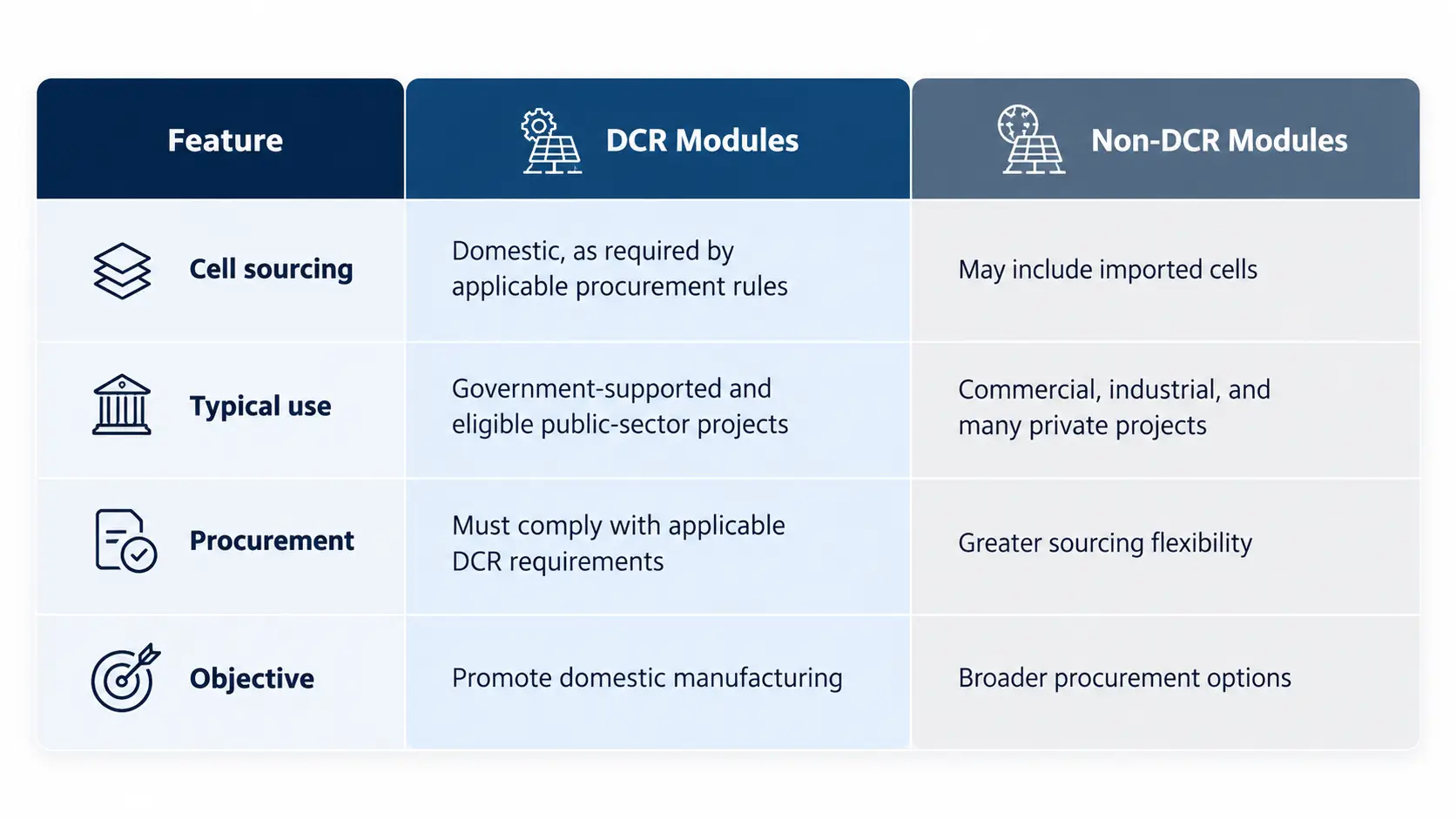
It is important to note that DCR status does not automatically determine a solar module’s efficiency or reliability. Performance depends on factors such as cell technology, manufacturing quality, testing standards, and quality assurance processes.
Which Projects Require DCR Solar Modules?

Certain government-backed solar programs, public-sector tenders, and projects funded under specific MNRE guidelines may require DCR-compliant modules. Tender documents generally specify whether DCR compliance is mandatory.
Private commercial and industrial projects, captive power plants, and several utility-scale developments may instead use Non-DCR modules, depending on project specifications and procurement policies.
Before finalizing module procurement, developers should carefully review the tender conditions and applicable government notifications.
Do DCR Modules Perform Better Than Non-DCR Modules?

One of the biggest misconceptions in the solar industry is that DCR modules are inherently more efficient than Non-DCR modules.
In reality, module performance depends on the technology used rather than its DCR classification.
Modern N-type solar panels, TOPCon Solar Modules, and bifacial solar panels offer advantages such as lower degradation, higher energy yield, and improved performance in
challenging climatic conditions. Whether these technologies are available as DCR or Non-DCR products depends on the manufacturer’s production capabilities and applicable compliance requirements.
Therefore, buyers should evaluate specifications such as efficiency, temperature coefficient, warranty, certifications, mechanical strength, and long-term reliability rather than assuming that DCR alone guarantees better performance.
Why ALMM Approval Matters

While DCR and ALMM are often mentioned together, they are not the same.
The Approved List of Models and Manufacturers (ALMM) is maintained by the Ministry of New and Renewable Energy (MNRE) and identifies eligible manufacturers and module models for projects that require ALMM compliance. Being listed in ALMM helps demonstrate that a manufacturer meets specified quality and compliance requirements for applicable government procurements.
When evaluating a supplier, buyers should therefore consider both:
- Whether the project requires DCR compliance.
- Whether ALMM-listed modules are mandatory under the applicable procurement guidelines.
How to Choose the Right Solar Module for Your Project

Selecting the right module involves evaluating both technical and regulatory requirements. Consider the following:
- Project type (government or private)
- DCR requirements in tender documents
- ALMM applicability
- Module technology (such as TOPCon Solar Module or N-Type Solar Modules)
- Manufacturer’s quality standards
- Product certifications
- Warranty and after-sales support
- Long-term reliability and supply consistency
Partnering with an experienced solar module manufacturer in India that offers advanced manufacturing capabilities, stringent quality control, and comprehensive technical support can help ensure project success.
Final Thoughts
Choosing between DCR and Non-DCR solar modules is not about deciding which one is universally better; it is about selecting the solution that aligns with your project’s regulatory requirements, procurement strategy, and performance expectations.
As India’s solar industry continues to expand, developers, EPC companies, and businesses should focus on compliance, technology, quality, and long-term reliability when selecting modules. Whether opting for DCR-compliant products for government-backed projects or Non-DCR modules for private installations, working with a trusted solar panel manufacturer in India ensures that your investment supports both performance and long-term value.